
Cyclic Voltammetry of ferricyanide system
Cyclic Voltammetry (CV) is an electrochemical technique used to investigate the oxidation–reduction behavior of molecular species and to analyze electron-transfer processes in catalytic reactions. It records the current response (I) as a function of the applied potential (V). The plot of the current charge versus the varying voltage is defined as a voltammogram. For an electrode, a minimum potential is required to initiate a reduction or oxidation reaction.
Voltammetric cell comprises of three electrodes system:
| S.No. | Working Electrode | Auxiliary electrode (Counter) | Reference electrode |
|---|---|---|---|
| 1. | Various geometries & material from small Hg drops to flat Pt disks | Passes all the current needed to balance the current observed at the working electrode | Give information about reversible half reaction. E.g. Calomel electrode |
| 2. | Mainly used materials Au, Pt, Glassy carbon electrode | Measuring & controlling of working electrode potential. |
A typical voltammogram of a reversible redox couple displays a pair of well-defined oxidation and reduction peaks, where the anodic peak corresponds to oxidation, and the cathodic peak represents reduction of the electroactive species. The separation between the anodic and cathodic peak potentials (ΔEp = Ea − Ec) is an important indicator of reversibility, with smaller values signifying faster electron-transfer kinetics and a more reversible system. The anodic peak current (iₐ) and cathodic peak current (ic) represent the maximum oxidation and reduction currents, respectively, while Ea and Ec denote the corresponding peak potentials. Additionally, the linear dependence of peak current on the square root of scan rate confirms a diffusion-controlled electrochemical process. An annotated diagram is provided to highlight peak positions, redox transitions, and potential scan direction for a better understanding of the electrochemical process.
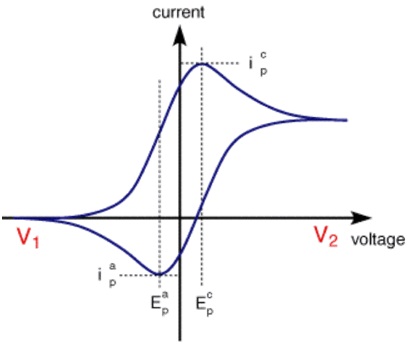
The ferricyanide/ferrocyanide redox system is selected for this study due to its well-established, reversible one-electron transfer mechanism, high electrochemical stability, and rapid electron-exchange kinetics. This makes it an ideal standard couple for evaluating instrument response, electrode performance, and understanding CV fundamentals. The voltammogram obtained clearly illustrates the forward oxidation peak (Fe(CN)₆⁴⁻ → Fe(CN)₆³⁻ + e⁻) and the corresponding reverse reduction peak on the return sweep, enabling interpretation of electron transfer dynamics. The cyclic voltammetry measurement of the ferricyanide/ferrocyanide redox system is carried out using a computer-controlled electrochemical potentiostat. It precisely controls the applied potential and measures the resulting current response during the forward and reverse potential scans, enabling accurate evaluation of the redox behavior, reversibility, and electron-transfer kinetics of the ferricyanide system.